

Screenshots

 Watch trailer on Steam ↗
Three Kingdoms Classic
SEEAT · Published by SEEAT · Official site ↗
Very Positive — 88% positive (129 reviews) · 63 achievements
Last updated 28 Sept 2026
Lead a Three Kingdoms warlord in a turn-based grand strategy simulation focused on logistics, diplomacy, officer management, and large-scale warfare.
£11.75
Lowest price we've ever recorded
View on SteamPrices can lag the live Steam store — always confirm before buying.
Price history
Simulation, Strategy · 2026 · More £5 - £15 games
About this game
Dynasties fall. A single order reshapes the map.
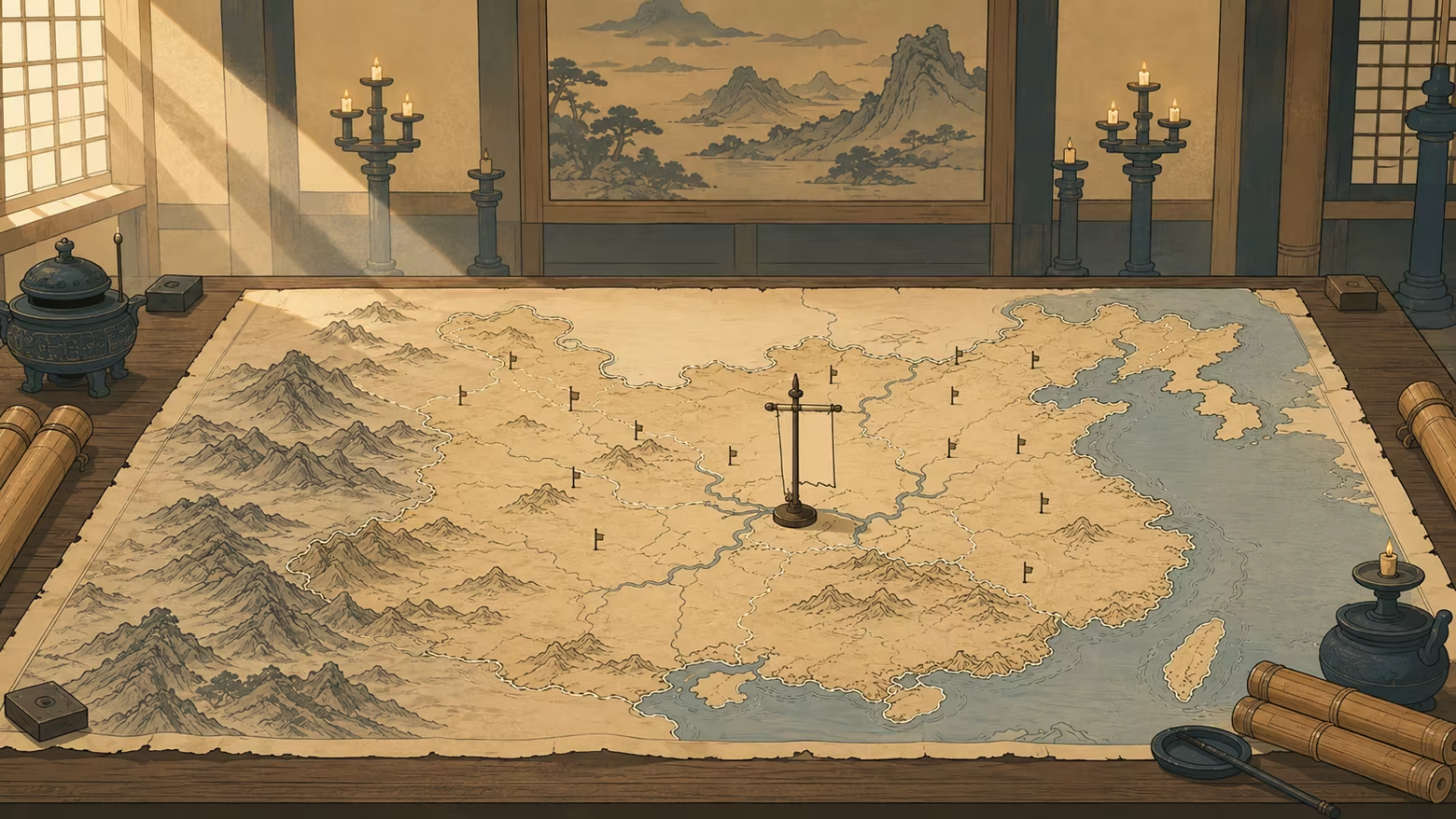
Three Kingdoms Classic is a turn-based grand strategy game based on the historical records of the late Han dynasty and the Three Kingdoms era. Through cities, officers, diplomacy, supply lines, and battlefield commands, you will guide a faction through an age of chaos.
The front line does not move by the sword alone. Deciding which city to relieve, which officer to trust with logistics, and whether to fight or hold your ground can gradually redraw the borders of the realm. You can take command of a faction and aim for unification, or watch the wars and diplomacy of AI-controlled factions unfold in Observer Mode.
Choose from multiple eras of conflict.
The realm did not split into three kingdoms overnight. From the Anti-Dong Zhuo Coalition and the rise of regional warlords to Guandu, the aftermath of Chibi, Liu Bei as King of Hanzhong, Wuzhang Plains, and the fall of Shu Han, each scenario offers a different balance of factions, officer deployments, front-line pressure, and historical events.
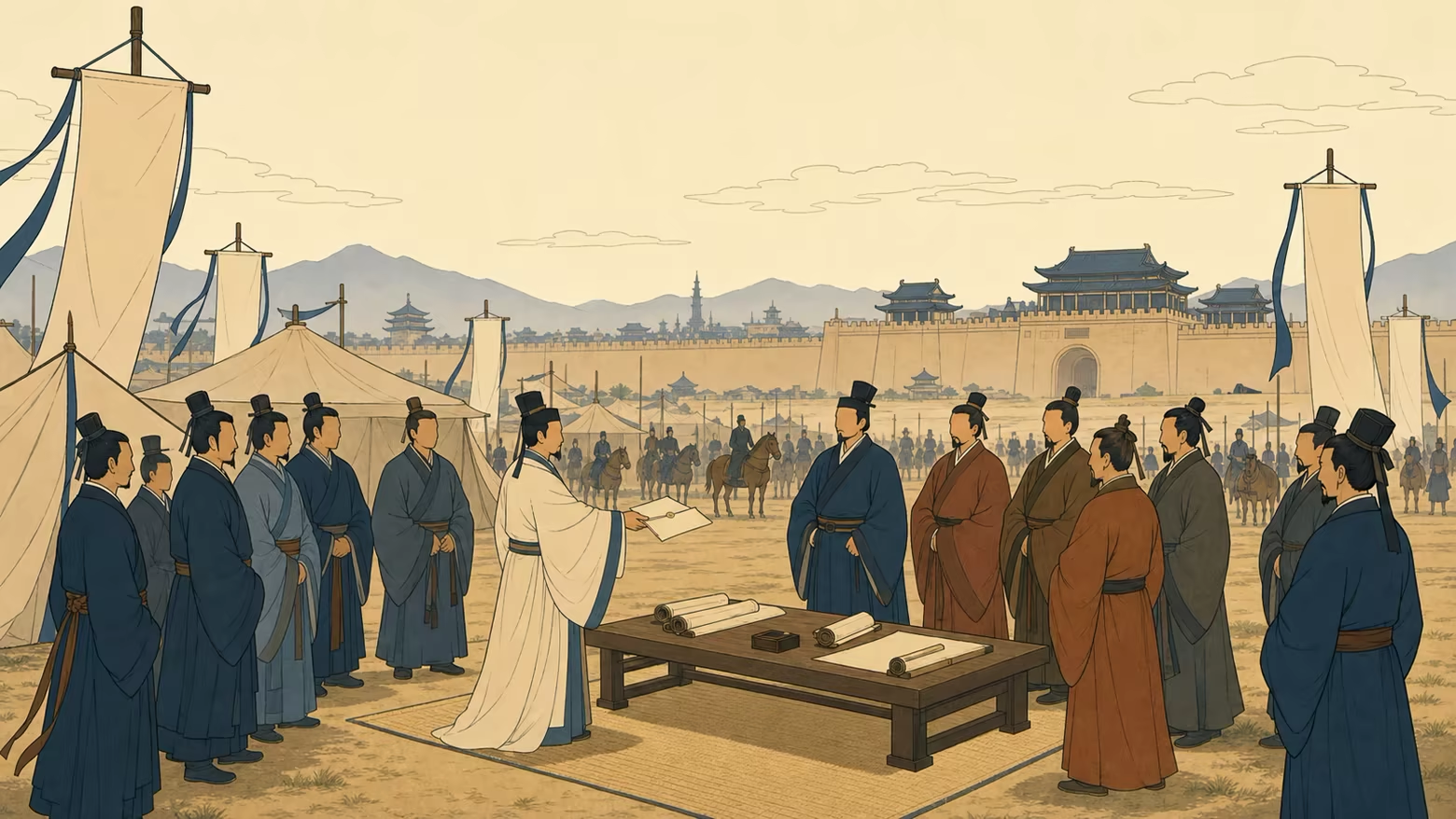
The passage of time is reflected in both the map and its people.
Three Kingdoms Classic represents each era with names, roles, and faction structures suited to that point in history. The same region may appear under a different name depending on the scenario, just as Yufu later became Yong’an, and Moling became Jianye.
Officers are also designed around their recorded deeds and historical roles rather than only their familiar popular images. Xiahou Dun excels as a commander who supports rear-area stability and logistics, while Zhang He shines through mobility and battlefield judgment. Historical grounding is reflected not only in background text, but also in city names, officer roles, abilities, and strategic use.
Cities are the foundation of war.
Cities on the map are more than territories to occupy. Population, gold, food, troops, public order, economy, agriculture, and logistics determine how long a war can be sustained. You must decide which cities to defend, where to gather troops, and where supplies should be sent.
If public order collapses, the risk of rebellion rises. If the front grows too long, reinforcements and supply transport take time. More important than winning the battle in front of you is whether you can still afford that victory next month.
Officers are more than numbers.
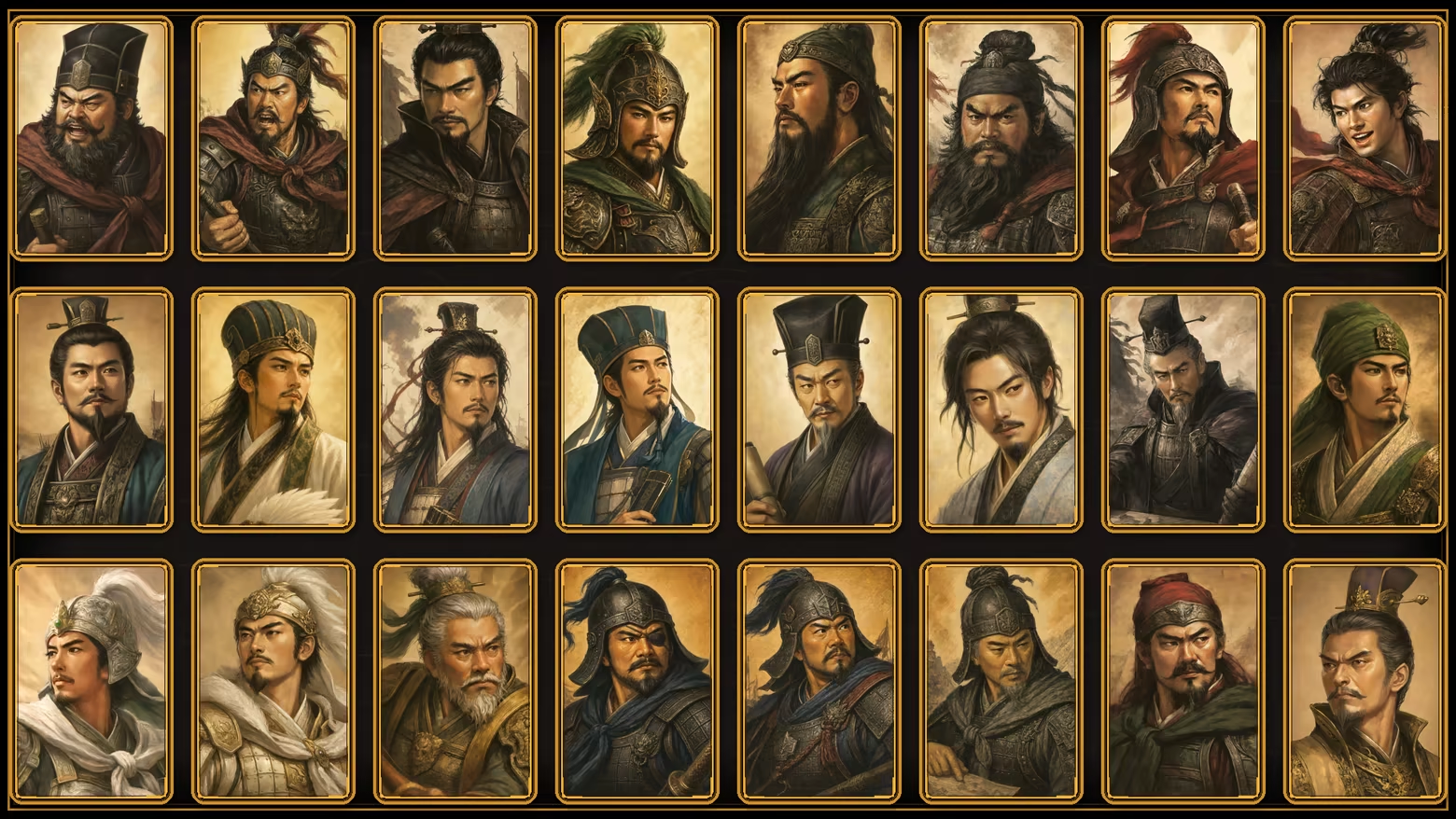
Behind every stat sheet is a person. Officers are not judged by combat ability alone. Their roles, personalities, traits, loyalty, relationships, biographies, and achievements all influence the front.
Strategists support supply lines and schemes. Fierce warriors lead attacks and defenses. Political officers strengthen city administration and diplomacy.
You can grant offices and titles to officers who distinguish themselves, preserving their loyalty and rewarding their service. You can also consider relationships and personalities when recruiting, negotiating with prisoners, or deciding their fate. Gaining a talented officer can matter longer than winning a single battle.
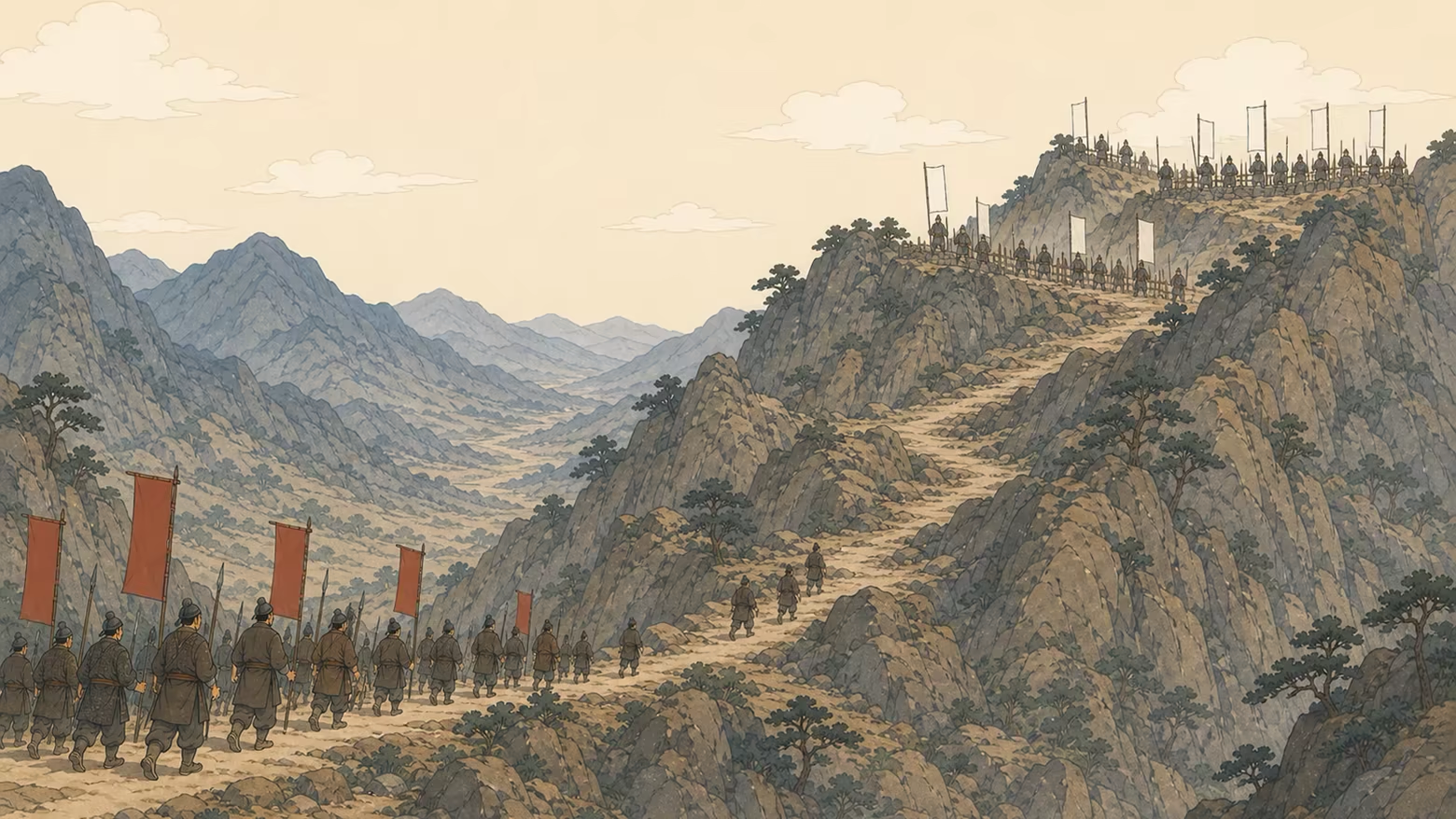
Battles unfold as operations over several days.
Attackers and defenders each choose their commands. In sieges, field battles, set-piece engagements, gate battles, and mountain battles, walls, high ground, supply lines, weather, morale, provisions, officer personalities, and traits can all lead to different outcomes.
Fire attacks, confusion, lures, supply raids, gate defense, and retreats can become decisive moves — or costly mistakes. A larger army does not always win. Which officer you place at the front, where you hold, and when you withdraw can change the course of battle.
“Setting camp on a mountain?”
This time, even Ma Su may have another chance. In mountain battlefields such as Jieting, high ground, supply lines, and the commander’s judgment can alter the tide. Take Ma Su’s place on the mountain and try to overturn the result of Jieting yourself.
A direct assault is not the only path to victory. Dangerous routes such as the Ziwu Valley, Yinping Trail, Han River routes, and river crossings or mountain paths in Jiangdong can give you a chance to strike behind enemy lines. But harsh routes reduce troops and morale, and if discovered, they may be cut off. History is not already decided.
Change the front through diplomacy and schemes.
Truces, alliances, joint invasions, requests for aid, recruitment, prisoner treatment, surrender and vassalage proposals, relations with non-Han tribes, and historical events can be as important as war itself. Instead of attacking immediately, you may buy time. By persuading a capable officer, you may change the outcome of the next battle.
A good truce saves your army. A bad truce merely tells you the exact date of the next betrayal. Who you join hands with, and who you delay, can redirect the arrows on the front line.
Authority and records are also part of ruling the realm.
Taking the realm is one thing. Holding it is another. A faction must manage not only territory, but also legitimacy. Offices and titles, relations with the Han court, imperial accession, abdication, and post-unification choices can all leave different endings for your campaign.
Your campaign can be reviewed through replays and historical records. The orders you gave, the deeds of your officers, and the rise and fall of factions remain as part of the record.
Key Features
Multiple historical scenarios covering major periods from the late Han dynasty to the end of the Three Kingdoms era
Historical maps and data reflecting era-specific city names, faction structures, and officer deployments
Strategic systems linking domestic administration, logistics, public order, food, and troop management
Officer data based on historical records, including roles, personalities, traits, loyalty, relationships, biographies, and achievements
Turn-based battles divided into sieges, field battles, set-piece engagements, gate battles, and mountain battles
Risk-and-reward operations through difficult routes such as the Ziwu Valley and Yinping Trail
Diplomacy and personnel management, including truces, alliances, joint invasions, aid, recruitment, prisoners, and vassalage
Historical events and alternate-history settings triggered by specific conditions
Custom officers and new faction options
Observer Mode for watching AI factions develop on their own
Campaign replays and historical records
Three Kingdoms Classic values long-term judgment over quick decisions.
A single city’s food shortage can collapse a front. A single officer’s defection can shift the balance of the realm.
Write the next chapter of the age of chaos with your command.
System Requirements
Will my PC run this? →Minimum
- Requires a 64-bit processor and operating system
- OS: Windows 10 64-bit or later
- Processor: 2-core / 4-thread x64 CPU or better
- Memory: 4 MB RAM
- Graphics: DirectX 11-capable GPU
- Storage: 2 GB available space
Recommended
- Requires a 64-bit processor and operating system
Supported Languages
Latest news
AnnouncementsOfficial
Three Kingdoms Classic 1.7.0 — Revolt on the Frontier
Hello. Three Kingdoms Classic 1.7.0, Revolt on the Frontier, is now live. This update introduces tribal expeditions, an official IF scenario and companion custom-officer pack, and an editor for campaigns already in progress. Tribal ExpeditionsYou can send expeditions against the Wuhuan, Xianbei, Qiang, Nanman, and Shanyue. Assemble your officers and troops, then watch the campaign unfold month by month. Its outcome depends on the forces committed and the approach you choose. The game can recommend officers, and troops can be drawn from multiple cities.A successful expedition brings loot and regional support while subjugating the target for a time. A subjugated power pays tribute and will not invade your territory. Defeat or withdrawal may provoke retaliation.You can track the expedition, make decisions during the campaign, and review the outcome when your forces return. Official IF Scenario and Frontier HeroesThe official IF scenario Frontier Uprising — Warlords of the Borderlands has been added. It begins in 195 with five frontier coalitions—Wuhuan, Xianbei, Qiang-Hu, Nanman, and Shanyue—occupying 17 Han cities. The Official Frontier Heroes custom-officer pack contains 30 figures associated with the Wuhuan, Xianbei, Qiang-Hu, and Shanyue frontiers, with new portraits reflecting regional clothing and equipment. The scenario requires both Official Frontier Heroes and Official Romance Heroes. In-Campaign EditorIn Standard mode, you can edit key campaign resources, officer stats, and specialties while a campaign is in progress. The campaign editor is unavailable in Hard mode. Save the game to keep your changes. Uprising and Disaster AdjustmentsReduced repeated popular uprisings in recently occupied or stabilizing cities.Disasters now cause greater loss of life, and natural population growth stops in an affected city while the disaster remains active. Research Tier IV and Late-Game DevelopmentEvery research branch now extends to Tier IV. Advancing beyond Tier III takes ...Read full article on Community Announcements (Seeat Official)AnnouncementsOfficial
Three Kingdoms Classic 1.6.0 — Hundred Vistas Under Heaven
Hello. Three Kingdoms Classic 1.6.0, Hundred Vistas Under Heaven, is now live. This update introduces Scenario Studio, a separate creator app where you can build battlefields of your own. Starting with the base game’s 62 cities and historical officers, you can reshape factions and starting positions, then add historical events, short-term objectives, and dedicated endings. Share your scenarios as ZIP files or publish them to Steam Workshop. Campaigns and replays preserve the scenario as it was when play began, even if the original pack is later updated or removed. Scenario Studio Launch Scenario Studio from Creator Tools on the main menu. Create a project from a blank 62-city map or the layout of a supported base-game scenario, then manage your automatically saved source project. The Studio currently lets you edit: Scenario title, description, author, start date, and optional translations in five languages Factions and their rulers, advisors, heirs, resources, tendencies, colors, and governments Ownership, population, development, troops, provisions, public order, fortifications, and naval strength for all 62 cities Whether base-game historical officers appear, along with faction, city, loyalty, relations, assignment satisfaction, and captive status Required custom-officer packs, the officers actually used from those packs, and automatically linked spouse and parent-child relationships Diplomatic relations between factions, the imperial court, province consolidation, and starting captives Custom historical events built from conditions, effects, dialogue, and illustrations Faction-specific short-term objectives and endings with up to 16 narration or officer-dialogue scenes Completed projects can be validated and exported as Scenario Pack ZIP files, published as new Steam Workshop items, or uploaded as updates to existing items. You can also import a compatible single-scenario ZIP back into a Studio project for further editing. Scenario Studio focuses on scenarios tha...Read full article on Community Announcements (Seeat Official)Patch NotesOfficial
Three Kingdoms Classic 1.4.0 — The Red Cliffs Update
Hello. Three Kingdoms Classic 1.4.0, the Red Cliffs update, is live. Its centerpiece is a new battle type: the river battle. River battles are fought with fleets on the rivers and lakes of the Yangtze basin. A fleet commander cannot steer dozens of ships moment to moment, and river battles are built around that: each side plans three commands in advance, then both operations are revealed and resolved together. To go with them, the old 209 "After the Battle of Red Cliffs" scenario has been rebuilt as 208 "The Battle of Red Cliffs." It used to open after the battle was already decided. Now you take command of the battle itself, from Cao Cao's chained fleet through Huang Gai's fire attack. This update also brings naval specialties, optional officer deaths in battle, the Two Tigers Ploy — a stratagem that drives two other forces into war — and a rebuilt tribal information screen. Loyalty and food production, the strategic AI, sieges and pass battles, court offices, and keyboard and controller support have all been improved, and long campaigns hold together better when it comes to saving, replays, and turn progression. River battles River battles break out across the waters of the Yangtze basin: Red Cliffs, Ruxukou, Xiakou, Poyang Lake, Dongting Lake, the Han River, the Yangtze, Lake Tai, and the Xiang-Gan waters. Every operation is built from three command cards chosen ahead of time. Both sides reveal their operations at once, and the cards resolve in the order you set them as the battle develops. Commands come in three roles. Fleet Deployment: sets your formation, which changes your attack power, your defense, and how you answer the enemy's blows. Maneuvers: take the channel or pull the enemy out of position to set up the attack that follows. Attacks: strike the enemy fleet with whatever your formation and maneuvers have prepared. Fleets can hold four formations: Massed Vanguard, Double Wings, Dispersed Line, and Linked Ships. Maneuvers are Feigned Retreat, Seize the C...Read full article on Community Announcements (Seeat Official)Patch NotesOfficial
1.3.2 Update Notice
Hello everyone.Update 1.3.2 for Three Kingdoms Classic is now available.This update broadly improves accessibility and screen readability when playing with only a Steam Deck or keyboard.In the compact layout, focus navigation between the command menu, map, and right-side information panel has been reorganized for keyboard and controller input. Controls have also been improved for the start menu, battle formation screens, and officer detail action menus.The successor selection screen has also been redesigned. The candidate list and detail panel are wider, while portraits, traits, officer evaluations, and biographies are now easier to review.Food production differences based on city population have also been moderately increased, and AI attack and defense decisions have been improved. Siege preparation has been simplified by removing the separate troop allocation step, allowing players to focus on selecting the commander, deputy officers, and formation.The main changes are as follows.Steam Deck and keyboard controls have been improved.Keyboard and controller navigation between the command menu, map, and right-side information panel is now supported in the compact layout.Settings, Battle Training, and Replay screens in the start menu can now be operated with the arrow keys, WASD, Enter, Space, and Esc.Fixed cases where the selection indicator could lag behind or become misaligned with rapid directional-key input.For Steam Deck, select and launch the Gamepad with Camera Controls template as your controller layout.Successor selection and officer information screens have been improved.Widened the successor selection screen and candidate list, and increased portrait sizes.Applied the same portrait frames used in other officer lists to successor candidates.In IF Mode, the screen displays actual stats. In normal mode, it focuses on officer evaluations and biographies.Added context-sensitive commands to the officer detail screen. Allied officers can be rewarded or transferred...Read full article on Community Announcements (Seeat Official)Patch NotesOfficial
1.3.1 Update Notice
Hello everyone.Update 1.3.1 for Three Kingdoms Classic is now available.This update improves the tools and interface used to create and edit portrait packs.A grid preview closer to the actual in-game display has been added, while editable officers are now organized by category and sorted by name, making it easier to find specific characters. The range and capacity of user-created portrait packs have also been expanded.Text input and keyboard controls have also been refined. We fixed an issue where game hotkeys could activate while composing Korean text or entering characters, and made keyboard navigation in search fields and popup screens more consistent.On Windows, BGM playback now uses less memory, improving stability during longer play sessions.This update also adjusts diplomatic relations during war, fixes internal city IDs appearing in recent events, and revises Zhang Lu’s starting forces in the Red Cliffs scenario.The main changes are as follows.Portrait pack editing has been improved.Added a grid preview that more closely reflects how portraits appear in the game.Organized editable officers by category and sorted each category by name.Expanded the range and capacity of user-created portrait packs.Improved error handling so that a problematic preview file no longer prevents the entire editing screen from being used.Text input and keyboard controls have been improved.Fixed an issue where game hotkeys could activate while entering text in officer information, enfeoffment, prisoner disposition, realm name, and search fields.Improved arrow-key navigation between search fields and search results.Standardized keyboard navigation for popup tabs, lists, and scrolling.Windows BGM playback has been improved.Reduced the amount of memory used during BGM playback.Improved stability during extended play sessions.Diplomatic relations and localization have been improved.Diplomatic relations between factions at war now gradually decline to reflect their hostile state.Fixed an ...Read full article on Community Announcements (Seeat Official)


