

Screenshots

 Watch trailer on Steam ↗
PODER
107 Games · Published by 107 Games · Official site ↗
Last updated 5 Sept 2026
Run a district in a 12-million Latin American megacity in a political strategy about power, compromise, and dirty deals. 100+ starting combos, 75 population groups, and no decision without consequences. Can you do better than those you love to hate?
Simulation, Strategy · 2027 · More free games
About this game
You are the district manager of a 12-million-person Latin American megacity, where every day brings new crises and difficult decisions. Fix a road and downtown demands a school. Block a corrupt deal and your party cuts your funding. Support a developer and your district will remember it. The city never slows down. Every solved problem creates another, and every choice has consequences.
Before you even begin, your path is shaped by one of 5 hero backstories, one of 5 political parties, and one of 18 districts, more than 100 unique starting combinations in total. Navigate corruption, political pressure, and competing interests while building your reputation and deciding how far you're willing to go to stay in power.
 Before the game even begins, you shape your fate. You choose a hero backstory, a political party, and a district, creating a unique combination that defines your starting situation. A tough starting choice turns the early game into a test of survival. An easy one gives you a chance to rise.
Your backstory determines who you are and what you have. Your party determines who has your back and what they'll demand in return. Your district determines what crisis you'll face from the very first minutes: debt, crime, crumbling infrastructure, or all three at once.

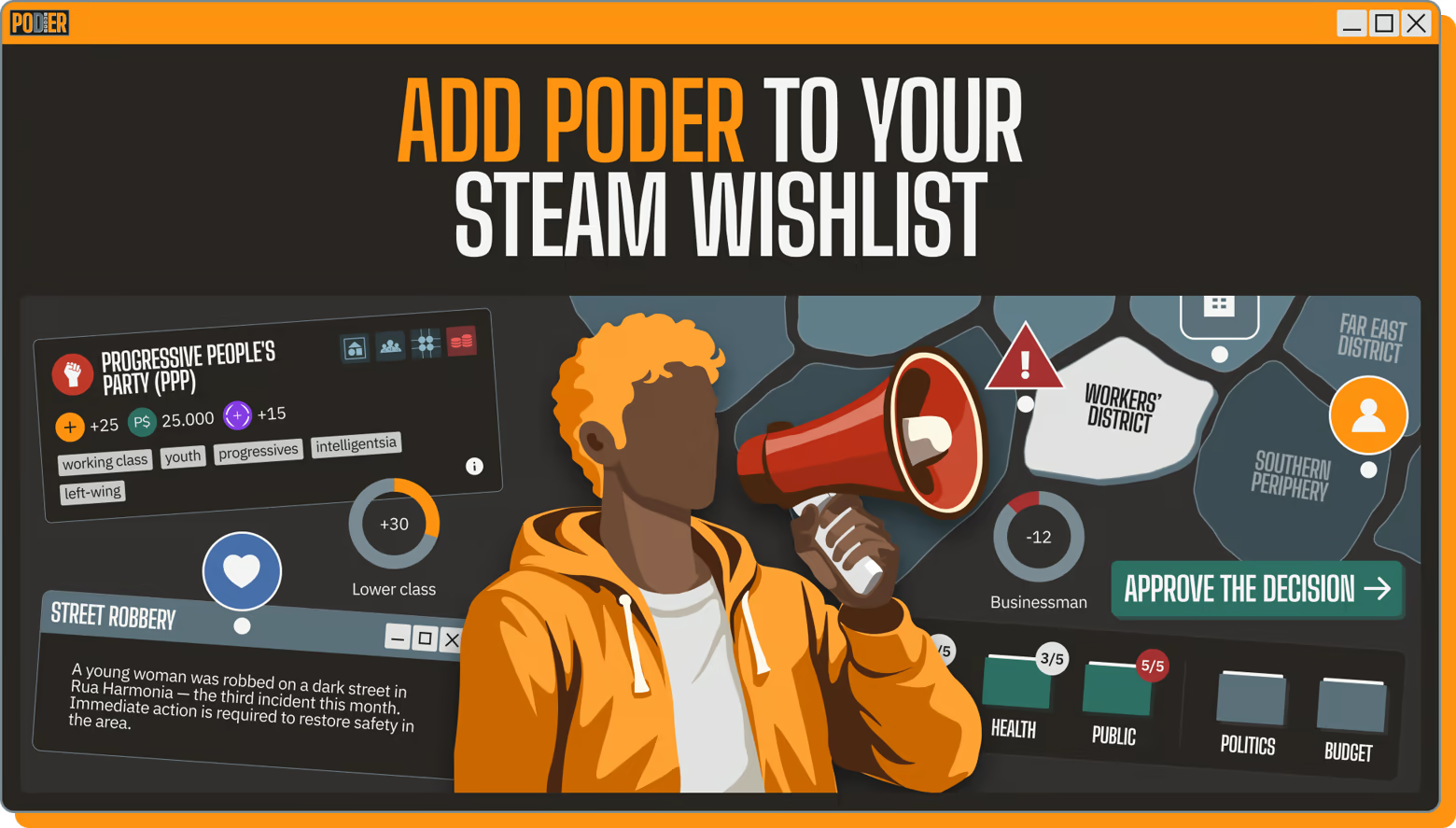
In PODER there are no abstract citizens. It features 75 specific population groups: by income, age, and beliefs. Young liberals vote for reform until reform hits their neighborhood. Retirees value order as long as you deliver it. Workers support whoever doesn't forget their district, and turn away the moment they feel ignored.
Every group reacts to your actions, not your words. They remember what you promised and compare promises to results.
 PODER is not propaganda. The game won't tell you which ideology is best. Privatize everything or nationalize it. Play by the rules or play dirty. Build your career honestly or climb over others. The game only shows what happens next. Sometimes immediately. Sometimes much later, when you've already forgotten how it all started. The most effective path isn't always the most honest one. And the most honest one sometimes leads to failure.

The district is just the beginning. Manage it well, and new opportunities open up. But with every promotion, decisions get more expensive and enemies multiply. Everyone is sure they could do better than a real politician. PODER doesn't argue, it lets you try.
System Requirements
Will my PC run this? →Minimum
- Requires a 64-bit processor and operating system
- OS: Windows 10/11 64-bit
- Processor: Intel Core i5-8400 / AMD Ryzen 5 2600
- Memory: 8 GB RAM
- Graphics: NVIDIA GTX 1060 / AMD RX 580 (4 GB VRAM)
- DirectX: Version 11
- Storage: 4 GB available space
- Sound Card: DirectX compatible
- VR Support: -
- Additional Notes: -
Recommended
- Requires a 64-bit processor and operating system
- OS: Windows 10/11 64-bit
- Processor: Intel Core i5-8400 / AMD Ryzen 5 2600
- Memory: 16 GB RAM
- Graphics: NVIDIA GTX 1060 / AMD RX 580 (4 GB VRAM)
- Sound Card: DirectX compatible
- VR Support: -
- Additional Notes: -
Supported Languages
*languages with full audio support
Latest news
AnnouncementsOfficial
Devblog #4: One city — five different ways to see it
The same city never looks the same to everyone. People living on the same street can have completely different incomes, backgrounds, and ideas about how things should work. For a lot of people it means opportunity. For just as many, it's a daily grind with no end in sight.PODER doesn't have one "correct" entry point. Instead, there are 5 backstories: a union leader, a former military officer, a community activist, a doctor, and a businessman. Each of them comes to power with their own history and their own understanding of what the city is. These aren't just different starting conditions — they're different ways of seeing the same system. A decision that feels obvious from one position can be impossible from another. One of them is the community activist.He grew up in a favela and knows what life there actually looks like — no filters, no illusions. He started with street-level initiatives, built an NGO to support local youth, fought against violence and drug trafficking, and over time became someone people actually listen to. They call him "the voice of the people" — not because he's the loudest, but because they trust him.He lives modestly, with almost nothing to his name: a minimal NGO salary and the weakest financial start in the game make every resource count. What he does have is people's trust and the backing of community organizations.For him, the city isn't a set of metrics or a management problem. It's specific people with everyday struggles that get ignored from the top far too often. If the system doesn't take this into account, then the problem is in the system, not in the people.He has real moral authority and name recognition in poor neighborhoods, but almost no connections inside the halls of power. He's a character who starts from the bottom — his leverage isn't money or access, it's reputation and the community behind him.He knows how to mobilize people and get things moving without a budget. But when it comes to backroom deals and political maneuv...Read full article on Community Announcements (main)AnnouncementsOfficial
Devlog #3: Politics as an OS — how we built PODER's visual identity
Where did this art direction come from?When we started working on PODER, we realized something pretty quickly. Most games about politics either turn it into a heroic story with "right" answers, or into satire where everything hides behind jokes and made-up scenarios. Either way, the same thing gets lost - the sense that any of it is real. And that's exactly what mattered to us. We wanted to build a political strategy game that shows power from inside the machine, not from the hero's chair. One that helps you see why a decision that works for some people is always a problem for others.That's where the core idea behind PODER's identity came from: this isn't a world you look at. It's a system you work inside. So the main visual metaphor is politics as an operating system. Not figuratively - literally.You're not out on the streets. You're not in the middle of the action. You're sitting in an office, behind a computer. In front of you — an interface, work windows, notifications, charts. Desktop folders are your city's departments: security, utilities, healthcare, social affairs. Notifications are events and problems that need your attention. Work windows are where you make decisions and run the system. And behind the monitor, a brick wall — a quiet reminder that the city is built gradually, one step at a time, through your actions.But it didn't take long to realize that "the system" alone isn't enough, because behind every number there are people. That's how the second visual metaphor was born — the pulse as the rhythm of decisions and city life.The city doesn't just exist - it lives and reacts. When things are stable, the rhythm is steady. When a crisis hits, it speeds up - noise creeps in, micro-animations, tension.This tension between system and life, the contrasts running through everything - that became the foundation of the entire identity.Color palette and shapesWe don't just have a nice-looking palette. We have a color system:Black, dark brown, white, and light g...Read full article on Community Announcements (main)AnnouncementsOfficial
Devlog #2: The idea behind PODER
The ideaHere's something that's been bugging us for a while. People don't get each other anymore. Not a "they're stupid" kind of thing — more like everyone's living in their own version of reality. Different priorities, different life experience, different sense of how things ought to work. And there's basically no way to step into someone else's shoes and see what they see.At the same time — politics stopped being background noise a long time ago. It's not some abstract thing happening far away. It's in your rent, your paycheck, your commute, who you can talk to without starting a fight. Most of us didn't ask for that level of involvement, but here we are.We're based in São Paulo. Biggest city in Latin America, 12-plus million people. Walk down one street and you'll bump into a dozen completely different ways of seeing the world — different classes, different needs, different ideas about what this city even is. Honestly, sometimes it doesn't feel like one city. It feels like five or six of them stacked on top of each other. And that got us thinking — how does anyone run something like this? How do you make most people happy without completely screwing over the rest? That's basically where PODER came from.We specifically wanted to set it in Latin America, and Brazil in particular. This country is huge, messy, full of contradictions — and none of that is for dramatic effect. That's just how things are here. We wanted a game that actually deals with the stuff people care about in real life, not some sanitized version of politics.How it playsPODER is a strategy game. You're a mayor. You run a city. But the point isn't to "win" in some traditional sense — get promoted, get reelected, hit some score. The point is to get under the hood of how a city actually functions, and to understand what people need when their worldview is nothing like yours.Most political games boil "the people" down to one approval meter. Maybe a few factions if you're lucky. We have 75 different po...Read full article on Community Announcements (main)


