
Screenshots

 Watch trailer on Steam ↗
Project Enceladus
Tamás Fülöp · Published by Tamás Fülöp · Official site ↗
Content notice: This game contains themes of crime and murder, but no direct depictions of extreme violence. Some scenes may feature blood or brief flashbacks related to past events. The overall atmosphere is dark and suspenseful, with psychological thriller elements.
Last updated 6 Oct 2026
A first-person puzzle-platformer psychological horror where you explore the fragmented mind of a murderer to uncover the truth behind a tragic space station massacre.
Action, Adventure, Indie · 2027 · More free games
Explore the twisted psyche of a space station killer in Project Enceladus, an action-adventure puzzle-platformer where every decision unravels deeper horrors.
About this game
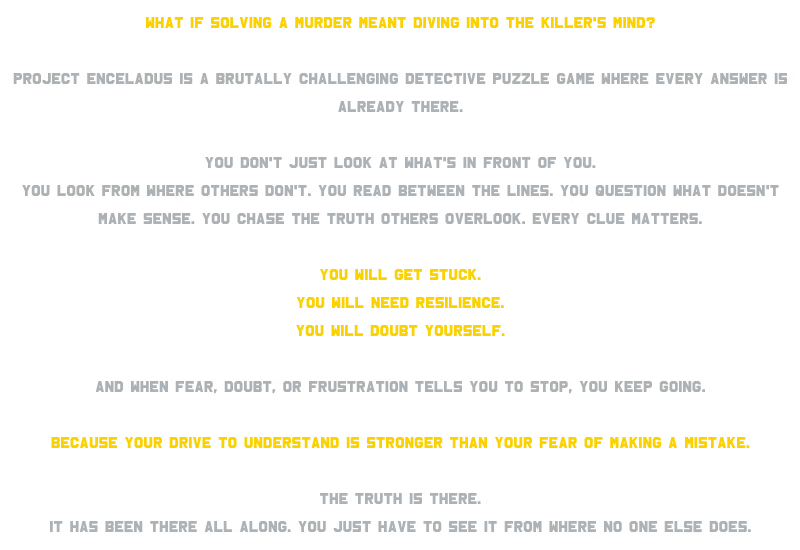

Investigate the sealed mind of a murderer using experimental simulation tech.
Your job isn’t just to observe, it's to interact, question, and uncover. But be warned: the simulation reacts to you. It evolves. And not everything wants to be found.
Explore recorded memories, redacted logs, and environmental clues to reconstruct a hidden narrative that spans both the real and simulated worlds.

Your most powerful tool? A remote manipulation energy provided by simulation.
Grab, move, rotate, and stack objects with precision, at range.
Solve puzzles by guiding energy cubes, redirecting power, and aligning components without touching a thing.

From switch puzzles to multi-state logic rooms, the game challenges you to think in systems.
You’ll route energy, control logic gates, activate hidden conditions, sometimes remotely, sometimes under pressure.
Some puzzles ask you to solve. Others ask you to observe.
The solution may not be in front of you, but above, behind, or hidden in plain sight.

Navigate the simulation with agility and style using your traversal-enhanced suit:
Dash past dangers or across collapsing floors
Double jump for extended reach
Climb and vault through vertical spaces
Traverse environments built around rhythm, physics and timing
Your movement matters. It’s not just how you solve, it’s where you can go next.

Your integrated Scan Pulse reveals what's not immediately visible.
Detect clues embedded in the walls
Highlight interactive objects
Reveal hidden inputs or power lines
Track connections across rooms
Discover temperature zones
Some secrets simply won’t show themselves without it.

Your deployable drone gives you eyes and access where you can’t follow.
Fly through vents and maintenance shafts
Trigger pressure pads or switches
Observe puzzles from alternate angles
Navigate hostile or unstable areas
Some rooms are designed for two, you and the drone.

Every puzzle is part of something larger.
Each is tied to a Clue Thread, a narrative arc in the mind of Dr. Noah Valen.
Some puzzles are required. Others are hidden, optional… and sometimes don’t want to be found.
Optional challenge rooms represent Noah’s subconscious — raw, unstable fragments of his mind.
Here, puzzles are symbolic, harder, and offer deeper insight into the truth he’s trying to bury.

From sterile chambers to warped halls swallowed by shadow, no two areas look or feel alike.
Environments constructed from memories, emotion, and trauma
Lighting and architecture that tell the story without a word
Areas that change as you complete objectives
A sense of isolation, discovery, and wrongness, that builds constantly
As you progress deeper into the simulation, reality begins to fracture.
Spaces twist, logic breaks, and the world around you becomes a reflection of a mind unraveling.
System Requirements
Will my PC run this? →Minimum
- OS: Windows 10 (64-bit)
- Processor: AMD Ryzen 5 3600 or Intel Core i5-9600K
- Memory: 16 GB RAM
- Graphics: NVIDIA RTX 2060
- DirectX: Version 12
- Storage: 15 GB available space
- Sound Card: DirectX compatible
- VR Support: Nem
Recommended
- OS: Windows 11 (64-bit)
- Processor: AMD Ryzen 7 5800X or Intel Core i7-12700K
- Memory: 16 GB RAM
- Graphics: NVIDIA RTX 2080 or AMD RX 6800
- DirectX: Version 12
- Storage: 15 GB available space
- Sound Card: DirectX compatible
- VR Support: Nem
Supported Languages
*languages with full audio support
Latest news
Patch NotesOfficial
Development Update
Chapter I — DoneChapter I is complete. That's the honest summary — but what "complete" actually means here took considerably longer to get right than expected.The biggest technical overhaul this chapter received was to the telekinesis system. The previous implementation relied on Unreal Engine's built-in PhysicsHandle grab — it worked, but it never felt right. Objects didn't respond naturally to momentum, collisions felt floaty, and fine placement was frustrating. The entire system has been replaced with a custom physics-based implementation written from scratch in C++. Every object interaction is now driven by a PD controller — proportional-derivative force calculations that account for position error, velocity error, angular damping, ramp-up curves, and force limits in real time. Light cubes feel weighted. Heavy cubes resist and push back. Throwing something now has actual momentum behind it. It's a foundational mechanic, and it finally feels like one.The character movement system received a similarly complete replacement. The project had been using ALS — Advanced Locomotion System — a widely used Unreal plugin that had been the backbone of the character since early development. ALS is a capable system, but it's dated, carries significant overhead, and wasn't built with Project Enceladus's specific needs in mind. It's gone. In its place is a fully custom movement feel component, also written in C++, that handles everything from procedural camera tilt during strafes and landing states to looping shake transitions between idle, walking, running, dashing, and mantling. The movement now responds to the game's gravity system directly — which matters more than it might sound, because Chapter II is going to need it.Beyond the two major rewrites, Chapter I received a thorough pass on everything that had been left imperfect since the Megagrant demo push earlier in the year. A significant number of bugs were hunted down and fixed — some of them had been present since very e...Read full article on Community Announcements (Tomaytoe)AnnouncementsOfficial
Thank you
Hey everyone!2025 has been an incredible year for Project Enceladus, and I wanted to take a moment to share where we're at.What's Been AccomplishedThis year, the game has transformed from early prototypes into something real. The game now has 5 fully playable levels, Chapter I. with the Prologue are nearly complete. Every placeholder asset has been replaced with final models, new mechanics like the drone system have been fully integrated, and the game is finally starting to look and feel like the vision we've always had.The JourneyIt hasn't been without challenges — my PC decided to die halfway through the year (great timing, right?), but we pushed through and kept moving forward. Indie development is never a straight line, but every obstacle has made the project stronger.What's NextWe're about 2 months away from completing the Prologue and Chapter I. After that, it's full focus on Chapter II and pushing toward our Q4 2026 release.The Steam page has been completely refreshed with new visuals and our first gameplay trailer. If you haven't seen it yet, check it out!Your wishlists and support mean everything. Knowing there are people excited about this project keeps us going through the late nights and tough problems.2026 is going to be huge. Thanks for being part of this journey.Thanks for reading, and for being part of this journey!– Tamás and The TeamRead full article on Community Announcements (Tomaytoe)Patch NotesOfficial
What’s New – Autumn Dev Update
A lot has happened since our last update in July. Tomi has been hard at work expanding Project Enceladus, creating new things and reworking some old ones, and today we'd love to share some of the progress that's been made across level design, puzzle systems, and gameplay flow.Leveling UpThe modular level-building workflow has evolved significantly. New rooms now feature more verticality and layered layouts, enabling more interesting movement-based logic puzzles and platformer-like challenges to be created.A new sidekick in the worksOne of the biggest additions that's been implemented is a dual-character mechanic: the player can now switch out of the protagonist's first-person perspective to control a small, autonomous drone.The drone can fly, access unreachable areas, activate hidden switches, and uncover secrets. This system opens up fresh puzzle designs and narrative moments, and to be honest, developing and testing this feature was really fun.Warming upA new temperature system has also been introduced to shape puzzle logic and exploration.These dynamic hot and cold zones affect both character performance and environmental interaction. Players can deploy mobile control units to normalize extreme conditions and even fuse them with static emitters to expand their coverage. It's not just a visual gimmick, as frost, fogging, and visor feedback all add depth and immersion to the simulation.This is actually the second design pass on the mechanic. The goal was to make it interesting and novel without adding unnecessary complexity. The result now feels intuitive and rewarding.Facelifting some old contentLooking back to this year's spring and thinking about the rush to finish a demo for Megagrant, it always felt like with more time, things could really be better. So Tomi revisited those parts of development, hunted down bugs that have haunted the project since then, performed some serious optimizations, and gave the Prologue levels a more polished look. Look!Changes have a...Read full article on Community Announcements (Tomaytoe)Patch NotesOfficial
Dev Update – Optimization, Mocap & Darren’s Debut!
We’re back with another development update from Project Enceladus. This one dives a bit deeper into the techy side of things, so if you're into performance tricks, custom tools, and animation workflows — this is for you!Performance Upgrades – Custom Data Layers & HISMAs our levels grow larger and more complex, performance becomes a bigger concern — especially in a puzzle-platformer where flow and timing are everything.That’s why we built our own Data Layer system in C++. Unlike Unreal’s World Partition system, this gives us more precise control:Load/unload actor groups using tagsSpread the work over frames with FTSTickerKeep GPU usage stable and predictableIt’s lightweight, custom-fit, and perfect for our level design needs.We also implemented Hierarchical Instanced Static Meshes (HISM) in our new Hangar level — a massive open space filled with detailed assets.Let’s just say:Before HISM? Our GPU cried.After HISM? Silky smooth.We're now updating earlier levels to benefit from the same optimization.Mocap, but Make It Indie – Using Meta Quest for Hand AnimationTo bring our main character Darren to life, we needed fluid, believable hand animation — without a full mocap studio.So we built our own VR-based mocap workflow using a Meta Quest headset, directly inside Unreal Engine 5.The Setup:Meta Quest VR headsetFull-body IK systemCustom Blueprint + code logicIn-editor capture toolsClean-up and polish directly in UnrealExported animations used in gameplayIt's quick, scalable, and fits our indie toolkit perfectly.Meet Darren – Our Metahuman ProtagonistDarren, our lead character, now has a finalized Metahuman model — and it’s looking sharp.Since storytelling and expression are central to the game, we’re using the new Metahuman Animator plugin in UE 5.6 to drive facial performance and emotion in real time.It’s still early days, but we’re excited about how much nuance we can capture. We’ll share facial animation tests soon!What We’re Working on Next:Facial mocap testing and ref...Read full article on Community Announcements (Tomaytoe)AnnouncementsOfficial
Why Sci-Fi? Why Puzzles? Why Thriller? Why this style?
As we get deeper into development on Project Enceladus, we wanted to take a step back and share something a bit more personal: Why this game? Why this genre mix? Why this tone?The answer is layered. Like the game itself.Why Sci-Fi?For many of us on the team, sci-fi wasn’t just a genre we liked — it’s something that shaped how we see storytelling and creativity. We grew up watching, playing, and reading science fiction that wasn’t about laser guns or space battles… but about ideas.Stories that asked uncomfortable questions: What happens when technology outpaces humanity’s ethics? How far would we push science in the name of survival? Can progress and morality coexist?Games like SOMA, movies like Arrival, or even classics like 2001: A Space Odyssey showed us how deeply sci-fi can tap into human emotion — and into fear. Not fear of monsters… but fear of isolation, of the unknown, and of our own decisions.Why Puzzle-Platformer?We’ve always loved puzzle-platformers because they force you to engage with a space, not just run through it. You’re not just a player with a gun or a quest marker — you’re an active participant, testing and understanding the environment.Games like Portal and Q.U.B.E. 2 were huge inspirations. Not just for their puzzle design, but for how they told story through environment, voice, and pacing.There’s something special about solving a problem with your own reasoning, not just following instructions. It creates a personal connection between the player and the world.And from a design perspective: We love how puzzle mechanics let us blend gameplay and narrative — making each room, each space, each object… part of the story.Why Thriller?Let’s be honest — nothing pulls you into a narrative like tension and mystery. A sci-fi setting filled with clean corridors and logical puzzles is one thing… But when you start to sense that something is off, that the place you’re in has a darker history… that’s when immersion really kicks in.Thrillers thrive on uncerta...Read full article on Community Announcements (Tomaytoe)