

Screenshots

 Watch trailer on Steam ↗
Finite State Automaton Challenges
Tramolly Game · Published by Tramolly Game
Mostly Positive — 75% positive (12 reviews)
Last updated 27 Sept 2026
In this game, we will play with the simplest automaton model, Finite State Automaton, and use it to cope with 80 challenges.
£0.89
Lowest price we've ever recorded
View on SteamPrices can lag the live Steam store — always confirm before buying.
Price history
Strategy, Casual · 2023 · More under £5 games
Discover how to navigate complex scenarios using basic finite state automata in Finite State Automaton Challenges. Engage in strategic thinking and problem-solving through 80 diverse puzzles designed by Tramolly Game.
About this game
In this game, we will use the simplest automaton model, the Finite State Automaton, to cope with 80 challenges. They come from character string manipulation, binary numbers, and daily life. Don't worry if you are unfamiliar with Finite State Automaton; this game contains a tutorial to get started quickly. Also, you can read the following introduction.
Finite State Automaton
Finite State Automaton (FSA) is the simplest automaton type. A finite state automaton consists of several states and transition rules. A transition rule describes when a state transits to another. So, it looks like a metro map. The clients of a finite state automaton are the character strings. It decides which strings are accepted and which strings are rejected. For example, an FSA can accept valid emails, phone numbers, etc. Now, let's dive into the first example:
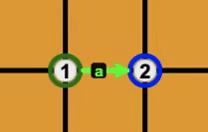
It has two states: the left state "1," and the right state "2". "1" marked with the green color means the automaton starts here. "2" marked with the blue color means that the automaton accepts the input string only if it stops here and read all characters in the order of the string. Consequently, this automaton is to accept "a" and reject any other string.
Question: try to design an FSA accepting "ab" and an FSA accepting "a" or "b" (abbr., "a|b") on your own (They are two challenges in the game).
Finite State Automaton with Various States
Traditional finite state automata have only three types of states: begin, accept, and normal. In this game, you can play automata with different states at different levels. The picture below shows an example.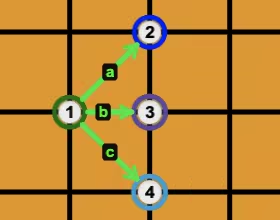
Non-deterministic
The most essential concept of FSA (and other automaton types) is called Non-deterministic. To introduce this concept, here is the second example of an automaton. It accepts all strings (only consisting of 'a' and 'b') ending with 'b':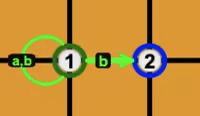
Run this automaton over "b" in your head: (1) It starts at "1", runs the self-loop of "1", then reads all of "b" as well as stops at "1", so reject "b"; (2) It starts at "1" and transits to "2", then reads all of "b" as well as stops at "2", so accept "b". A non-deterministic finite state automaton (NFA) accepts a string if at least one trace ends at a state marked with the blue color.
Run this automaton over "ab" in your head: (1) It starts at "1", runs the self-loop of "1" twice, then reads all of "ab" as well as stops at "1", so reject "ab"; (2) It starts at "1", run the self-loop of "1" once, and transits to "2", then reads all of "b" as well as stops at "2", so accept "ab."
Non-deterministic is essential because it allows the FSA to guess, which lets us design an automaton naturally (since we, human beings, like to guess) and quickly.
System Requirements
Will my PC run this? →Minimum
- Requires a 64-bit processor and operating system
- OS: Windows 10+
- Processor: I5
- Memory: 2 GB RAM
- Graphics: Intel UHD 630
- Storage: 256 MB available space
Recommended
- Requires a 64-bit processor and operating system
Supported Languages
*languages with full audio support
Latest news
AnnouncementsOfficial
v1.3 is out!
We add ten game levels, mainly about traffic lights and stocks.Read full article on Community Announcements (tramolly456)Patch NotesOfficial
v1.2 (a major update) is out!
In this update, we mainly add a new gameplay (Automaton with various states) and a more complete tutorial. Automaton with Various States Traditional finite state automata only have three types of states: begin, accept, and normal. From now on, we will have various state types for different levels. The below picture shows an example. {STEAM_CLAN_IMAGE}/44685939/1a002070af889b98f747ecf5bd3c8d2eaa23a095.png In this example, states 2, 3, and 4 are used to accept "a," "b," and "c," respectively. A more Complete Tutorial Now, we have a more complete tutorial. This tutorial begins by introducing the basic concepts of finite state automata, such as characters and strings. The picture below shows a multiple-choice question about the characters from this tutorial. {STEAM_CLAN_IMAGE}/44685939/3e0a7b36901681953494ed02df8fc760fdaa0bcf.png Other Like Finite State Automaton Challenges 2, we now have a reset button, which allows players to directly delete all states. The picture below shows this function. {STEAM_CLAN_IMAGE}/44685939/f7c172c8f3094ade8a799a7b0f828b663e6ebc88.pngRead full article on Community Announcements (tramolly456)AnnouncementsOfficial
v1.1 is out!
We make the following updates: add ten more levels. inherit the UI of finite state automation challenges 2. arrange levels by their fields, such as Mathematics and Daily Life, instead of difficulties. fix errors in level descriptions (Thanks to our players).Read full article on Community Announcements (tramolly456)AnnouncementsOfficial
Finite State Automaton Challenges 2 is coming!
In the second episode, you will play with the simplest automaton model, Finite State Automaton, and use it to cope with 40 challenges from variants of the previous episode, character string manipulation, computer science, and mathematics. We're making the game even more challenging and fun by introducing two major updates: A state can be both beginning and accepting. Some challenges require you to create a deterministic automaton (thanks for the suggestions from players), which means: There is at most one begin state. Empty edges are not allowed, i.e., each edge must contain at least one character. For a character, a state can transit to at most one state, i.e., no conflict edges.Read full article on Community Announcements (tramolly456)


